- +701-232-5697
- info@stratacominc.com

Modernizing ITSM with AI and Automation
Practical ITSM Guide
AI can make service management faster, more scalable, and easier to use. The value, however, comes from combining intelligent assistance with dependable automation, trusted knowledge, and disciplined service design.
The modernization principle
Use AI to understand, summarize, recommend, and predict. Use automation to execute approved work across systems. Measure both against service outcomes that matter to employees and the business.
Why ITSM modernization is urgent
Service teams are supporting more applications, more cloud services, distributed workforces, and higher employee expectations without a comparable increase in staffing or budget. At the same time, complex legacy platforms often require specialized administration, fragile scripts, and expensive upgrades.
This creates a capacity problem: the service desk cannot simply work faster. It needs a delivery model that prevents avoidable work, resolves routine requests automatically, and gives technicians better context for the issues that still require human judgment.
01
Reduce avoidable demand
Help employees find reliable answers and complete routine requests before a ticket reaches the service desk.
02
Accelerate resolution
Improve classification, routing, context, and fulfillment so technicians can resolve work with fewer handoffs.
03
Improve the experience
Make service easier for employees while returning technician capacity to complex, higher-value work.
AI and automation solve different parts of the problem
AI interprets and assists. It can understand an employee’s intent, summarize a long ticket history, recommend a response, find relevant knowledge, identify patterns, and generate a first draft.
Automation executes. It can create or update records, request approvals, provision access, synchronize data, notify stakeholders, and document every action.
Example: An employee requests access to a security group. AI clarifies the request and identifies the correct service. Automation creates the request, routes approval, updates the directory after approval, records the action, and confirms completion.
Where to begin: prioritize repeatable, high-volume work
Trying to automate the entire service catalog at once usually produces slow progress and difficult maintenance. A stronger approach is to identify the small number of services and request types responsible for most service desk demand.
Good candidates are frequent, predictable, supported by a clear policy, and capable of being fulfilled through reliable system actions. Common starting points include:
Identity and access: password assistance, group membership, and software access.
Employee lifecycle: onboarding, role changes, and offboarding.
Workplace services: device requests, common incidents, and status questions.
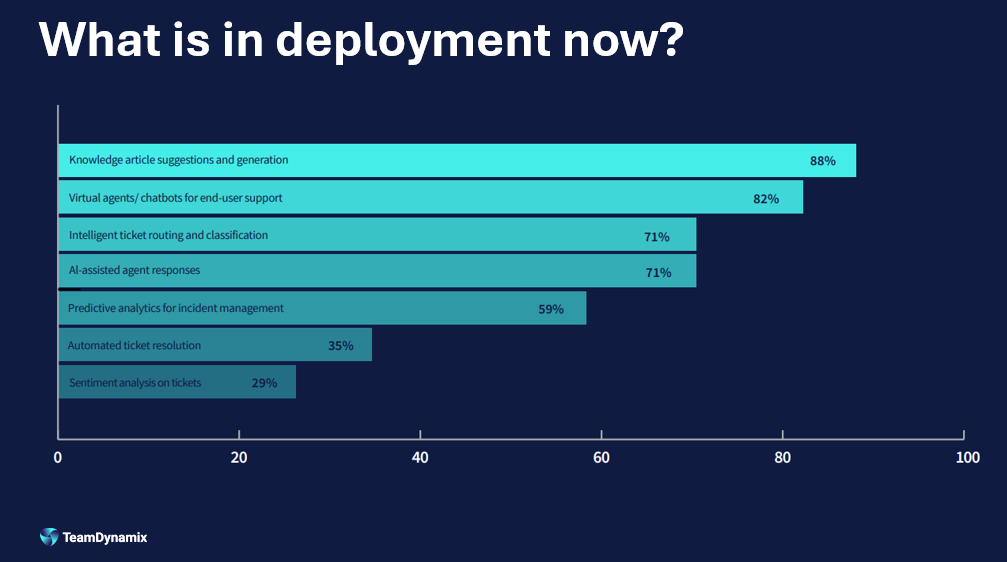
Technician assistance: ticket summaries, response suggestions, and routing.
A practical four-stage maturity roadmap
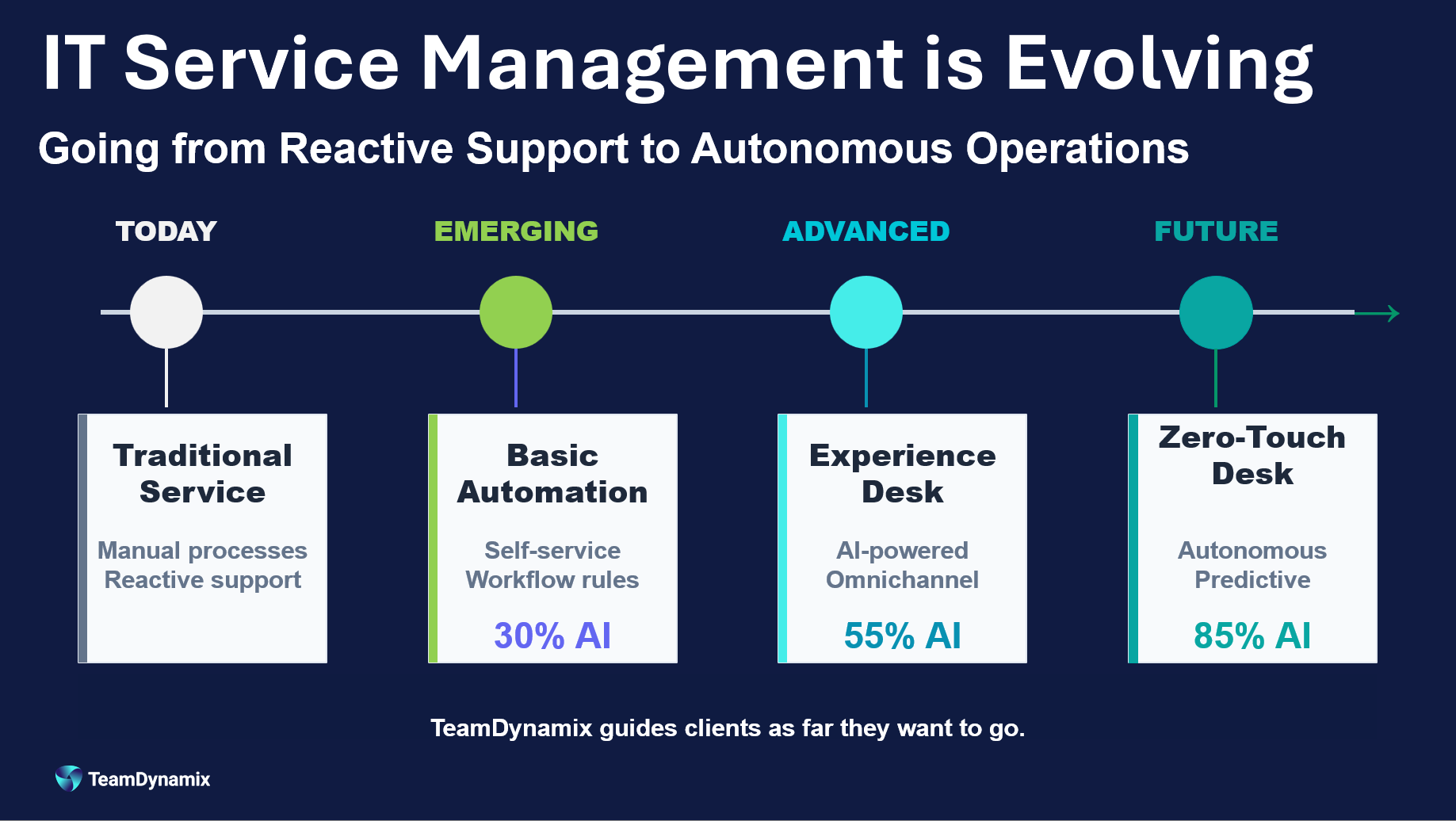
Stage 1
Strengthen data, classification, and routing
Use historical service data to improve categorization, assignment accuracy, priority, and reporting. This reduces manual triage and creates a dependable foundation for later capabilities.
Stage 2
Assist technicians and grow reusable knowledge
Introduce summaries, recommended knowledge, suggested responses, and draft articles. Keep people in the review process so published guidance remains accurate and useful.
Stage 3
Expand conversational self-service and fulfillment
Allow employees to ask questions in natural language and initiate approved workflows. Connect the experience to the service catalog, identity controls, and automation layer.
Stage 4
Add proactive and predictive service
Detect recurring patterns, emerging incidents, and experience degradation. Trigger remediation or technician review before employees need to report a problem.
Knowledge and data readiness
A perfect, centralized knowledge base is not a prerequisite. Useful information may exist in the ITSM platform, SharePoint, documents, runbooks, wikis, and resolved tickets.
Define authoritative sources, apply permissions, prioritize coverage for high-value services, and establish ownership for keeping content current. When the system lacks a reliable answer, it should fail safely and transfer the employee to a person or create a ticket.
Governance and trust
- Use approved data sources and role-based access.
- Keep approvals for sensitive or high-impact actions.
- Maintain an audit trail of prompts, decisions, and actions.
- Provide a clear human escalation path.
- Review generated knowledge before publication.
Design for maintainability, not just a strong demonstration
A pilot may look impressive while hiding long-term complexity. Technical evaluation should test how the solution will be operated, extended, governed, and measured after implementation.
Measure service outcomes from the beginning
Establish a baseline before the pilot. The goal is not to count AI interactions; it is to demonstrate a sustainable improvement in service delivery.
Ticket deflection
Assignment accuracy
First-contact resolution
Resolution time
Backlog and SLA performance
Knowledge reuse
Automation success
Employee satisfaction
Assignment accuracy
First-contact resolution
Resolution time
Backlog and SLA performance
Knowledge reuse
Automation success
Employee satisfaction
How TeamDynamix fits the architecture
TeamDynamix brings ITSM, enterprise service management, AI-assisted service delivery, virtual agents, and integration and automation capabilities into a unified platform. That architecture can reduce dependence on separate point solutions and fragile scripts while supporting governed workflows across IT and other business functions.
The right implementation starts with service outcomes and operating requirements, then maps platform capabilities to a phased modernization roadmap.
Build a practical ITSM modernization roadmap
StrataCom helps organizations assess service demand, knowledge, integrations, automation opportunities, and employee experience—then turn those findings into a prioritized, achievable plan.
Full Session
Watch Modernizing ITSM with AI and Automation
Explore the complete discussion for practical guidance on connecting AI, automation, knowledge, governance, and measurable service outcomes.