AI is quickly moving from experimentation into practical service management, but successful modernization requires more than adding a chatbot. Organizations need to connect AI with automation, trusted knowledge, governed workflows, and measurable service outcomes.
In StrataCom’s recent Modernizing ITSM with AI and Automation webinar, StrataCom Principal Consultant Eric Krueger joined TeamDynamix Chief Product Officer Andrew Graf and TeamDynamix Solutions Engineer Elizabeth Precht to discuss where AI is creating value today and how service leaders can build a realistic path forward.
1. Start with the outcomes that matter
Service organizations are supporting more applications, more cloud services, and higher employee expectations while facing staffing and budget constraints. The webinar centered on three outcomes that should guide every AI and automation initiative:
- Reduce avoidable ticket volume
- Shorten resolution time for work that reaches the service desk
- Improve the experience for employees and technicians
These outcomes keep modernization focused on business value instead of technology for its own sake.
2. Pair AI with automation
AI can understand a request, summarize a ticket, recommend a response, or draft knowledge. Automation completes the work by routing approvals, updating systems, provisioning access, and notifying the right people.
One example demonstrated during the webinar involved an employee requesting access to an Active Directory group. A virtual service agent clarified the group, created the request, obtained the required approval, and triggered an automated fulfillment process. The employee received faster service without requiring a technician to perform each step manually.
3. Focus first on high-volume services
Organizations do not need to prepare every process and every knowledge source before they begin. A practical starting point is to identify the small number of services and request types that generate most of the workload.
For each high-volume area, determine whether employees need better knowledge, a repeatable automation, or both. This narrower approach produces faster results and creates a foundation that can expand over time.
4. Build knowledge as part of daily work
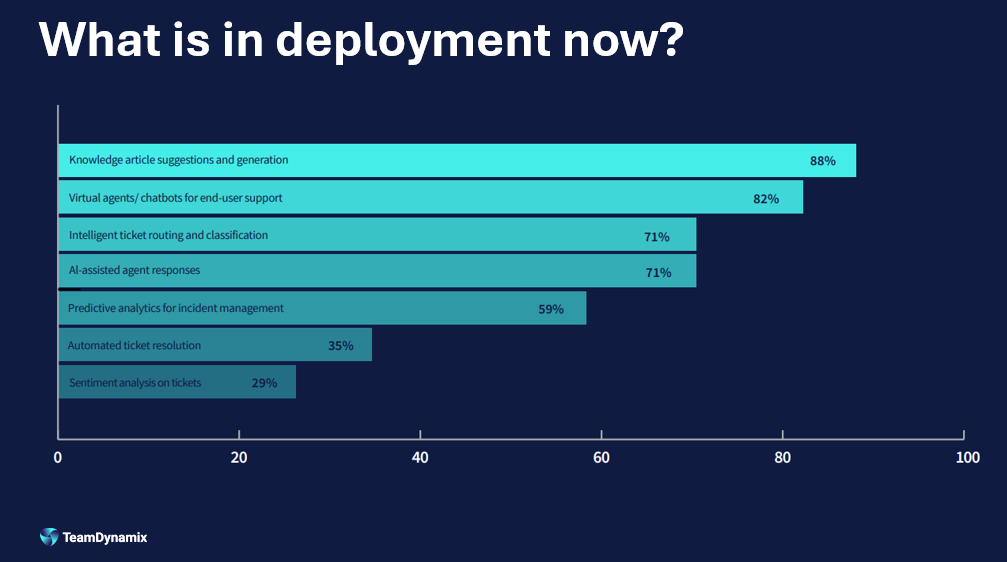
Knowledge is often spread across tickets, SharePoint, documents, runbooks, wikis, and other systems. AI can help technicians find and reuse that information, while also drafting new knowledge articles from resolved tickets.
A person should still review content before it is published. This human-in-the-loop approach improves consistency while reducing the effort required to grow a useful knowledge base.
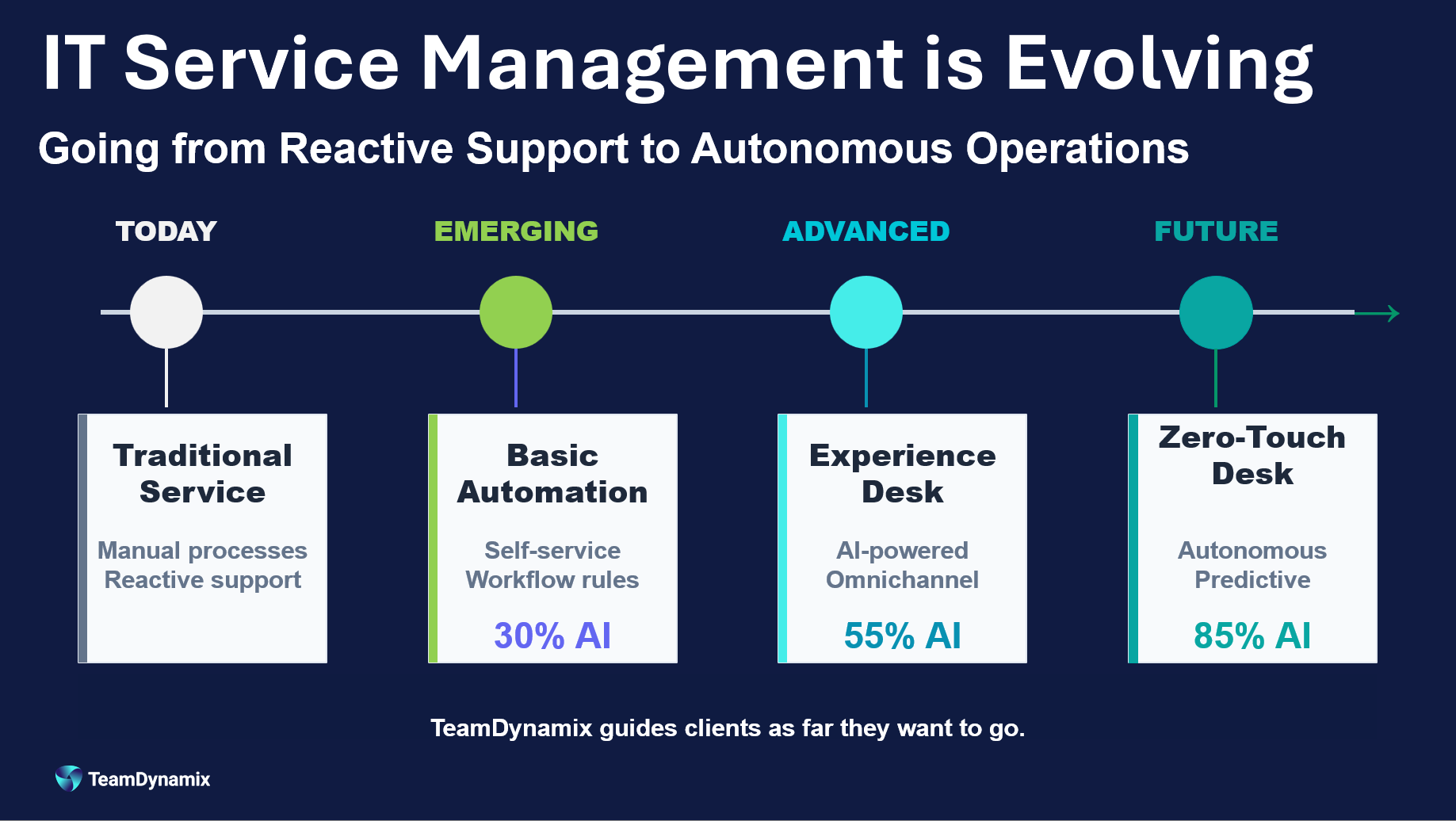
5. Follow a staged maturity roadmap
The presenters recommended a practical progression:
- Improve classification and routing. Use historical ticket data to reduce manual triage and misassignment.
- Assist technicians. Add ticket summaries, response suggestions, and knowledge recommendations.
- Expand virtual self-service. Let employees receive answers and initiate approved fulfillment workflows.
- Add proactive and predictive capabilities. Detect patterns and resolve issues before employees submit tickets.
This sequence helps organizations establish reliable data and workflows before moving into more advanced autonomous service use cases.
What to evaluate in an ITSM platform
Service leaders should look beyond a polished demonstration. The platform should be maintainable without extensive custom code, support deep and flexible integrations, provide auditable approvals and actions, and make it easy to measure ticket deflection, response improvement, automation success, and employee satisfaction.
TeamDynamix brings ITSM, virtual agents, AI-assisted service delivery, and enterprise integration and automation capabilities together in one platform. StrataCom helps organizations assess their current environment, prioritize the strongest opportunities, and build a modernization roadmap that aligns technology with business goals.
Read the detailed guide to modernizing ITSM with AI and automation.
Talk with StrataCom about your ITSM modernization roadmap.
Watch Modernizing ITSM with AI and Automation
Watch the complete session for practical guidance on combining AI, automation, knowledge, governance, and measurable service outcomes in an ITSM modernization program.